
Cardinal Digital Marketing Launches AI Growth OS for Healthcare Marketers
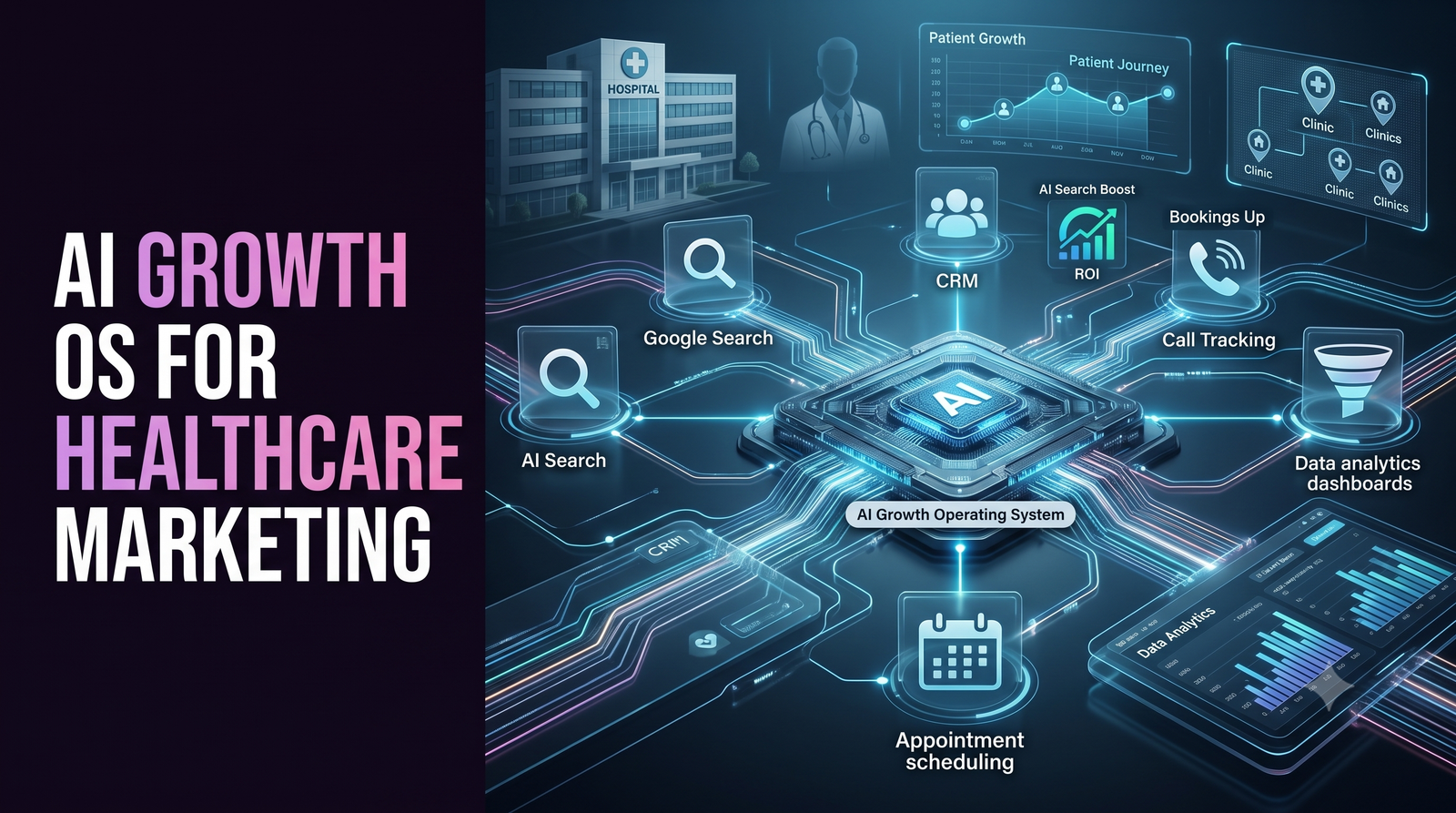
Cardinal Digital Marketing is bringing artificial intelligence deeper into healthcare marketing with a new AI-powered growth operating system designed to connect patient acquisition data, marketing performance and operational insights.
The healthcare marketing industry is moving into a new phase where clicks, impressions and lead volume are no longer enough to demonstrate growth.
Healthcare organizations increasingly need to understand a much harder question: Which marketing investments actually produce new patients, completed visits and sustainable revenue?
Cardinal Digital Marketing, the healthcare division of Power Digital Marketing, is addressing that challenge with its new healthcare AI growth operating system, introduced around its Scaling Up 2026 virtual healthcare marketing summit taking place October 13–14, 2026.
The company’s official event agenda describes the platform as Pulse, while Cardinal’s broader launch communications have referred to the AI growth operating system as OmegaHealth. The technology is positioned around a common objective: giving healthcare marketers a connected view of growth rather than forcing teams to piece together data from disconnected systems.
What Is Cardinal’s AI Growth Operating System?
Healthcare marketing is unusually difficult to measure.
A typical multi-location healthcare organization may have advertising platforms, a CRM, electronic health records, online scheduling, call tracking, analytics platforms and other operational systems—all producing valuable information independently.
The result is a fragmented marketing data environment.
One platform may report clicks. Another reports calls. A scheduling system records appointments. The CRM contains patient information, while the EHR contains downstream healthcare activity.
Connecting those signals is critical if marketing teams want to understand the complete patient acquisition journey.
Cardinal’s new AI growth operating system is designed to bring these different sources together and make the resulting information easier to use for day-to-day growth decisions.
According to Cardinal’s 2026 agenda, the platform is intended to provide a daily view of whether locations are pacing toward their goals, a natural-language analyst experience and tools for identifying problems that may be limiting new-patient volume.
From dashboards to AI-assisted decisions
Traditional marketing dashboards tell teams what happened.
An AI growth operating system aims to go one step further:
- What is changing?
- Which locations are underperforming?
- Where is patient demand being lost?
- Which campaigns are producing meaningful conversion signals?
- Is appointment capacity limiting growth?
- Which marketing problems require immediate attention?
- Where should additional budget be allocated?
- Are marketing leads actually becoming booked and completed appointments?
This distinction could become increasingly important as healthcare organizations manage hundreds of locations and multiple service lines.
Why Healthcare Marketing Needs Specialized AI
AI marketing tools are not automatically suitable for healthcare.
Healthcare marketers operate under privacy, regulatory and data-access constraints that are very different from many other industries.
They may also have significantly fewer usable conversion signals than retailers, ecommerce companies or other high-volume advertisers.
For example, an ecommerce company can potentially generate thousands of purchases every day. A healthcare organization may need to work with much smaller volumes of appointment bookings while also connecting those bookings to calls, scheduling, show rates and downstream patient outcomes.
That makes measurement architecture particularly important.
Cardinal’s Scaling Up 2026 program emphasizes this issue, including sessions on conversion-signal optimization, EHR-connected marketing, AI marketing analytics and healthcare measurement.
Connecting Marketing Data With Patient Acquisition
One of the most important ideas behind the new platform is the movement from marketing metrics to patient-growth metrics.
Healthcare executives typically care about outcomes such as:
- New patient bookings
- Kept appointments
- Patient volume
- Cost per new patient
- Location-level performance
- Revenue impact
- Capacity utilization
- Patient lifetime value
But marketing teams often report a different set of numbers:
- Impressions
- Clicks
- Cost per click
- Website sessions
- Form submissions
- Phone calls
- Conversion rates
Both sets of metrics matter, but they are not the same.
A modern healthcare marketing system needs to connect the two.
The real value is the connection
Consider a hypothetical healthcare network with 100 locations.
Suppose one location is generating a large number of leads but relatively few completed appointments.
A conventional advertising dashboard might classify the campaign as successful because cost-per-lead looks strong.
A connected growth system could reveal a different story:
Marketing is generating demand, but the scheduling process or appointment availability is preventing that demand from becoming patients.
That changes the optimization strategy.
Instead of simply increasing advertising spend, the organization may need to address scheduling capacity, online booking friction, call-center performance or appointment availability.
This is one of the most significant implications of AI-powered healthcare marketing: the marketing problem may actually be an operational problem.
Cardinal’s 2026 agenda explicitly explores this connection through sessions covering online scheduling availability, EHR-connected marketing and capacity-driven media planning.
AI Search Is Changing Healthcare Discovery
The launch comes at a particularly important time for healthcare SEO and search marketing.
Patients are increasingly encountering AI-generated answers during the information-gathering stage of their healthcare journey.
Google’s AI Overviews and AI Mode, along with other AI assistants, are changing how people research symptoms, conditions, providers and treatment options.
This creates a major challenge for traditional SEO.
For years, healthcare organizations have optimized around:
Search query → Google result → website click → conversion
The emerging journey can look more like:
Question → AI-generated answer → provider recommendation → website visit or direct action
That means a healthcare organization can potentially influence patient discovery without receiving the same number of traditional organic clicks.
Cardinal’s Scaling Up 2026 agenda dedicates multiple sessions to this shift, including discussions around AI search visibility, Google AI Overviews, AI Mode and the changing patient journey.
Healthcare SEO in 2026: Rankings Are No Longer the Whole Story
This does not mean SEO is becoming irrelevant.
Instead, healthcare SEO is becoming broader.
Healthcare brands increasingly need to establish:
- Strong topical authority
- Accurate medical information
- Provider expertise
- Trustworthy content
- Structured information
- Strong local signals
- Consistent organization and provider data
- Positive patient experiences
- Evidence of clinical differentiation
- Brand visibility across search and AI environments
The objective is no longer simply to rank for a keyword.
The bigger objective is to become a trusted source that search engines and AI systems can understand and confidently surface.
For healthcare organizations with hundreds of locations, that challenge becomes substantially more complicated.
The Patient Journey Is Becoming Nonlinear
Another major theme surrounding Scaling Up 2026 is the changing patient journey.
A patient might discover a provider through Google.
Another may encounter a healthcare organization through Instagram or TikTok.
Someone else may hear about a provider from a friend, search the provider later, read reviews, compare alternatives and finally schedule an appointment several weeks afterward.
That makes last-click attribution increasingly unreliable.
Cardinal’s event program specifically focuses on patient journeys that extend across social media, search, peer recommendations, websites, scheduling and repeat interactions.
For marketers, the implication is straightforward:
The first interaction and the final appointment may occur weeks or months apart.
AI-powered analytics can potentially help connect those fragmented interactions into a more useful picture.
Forecasting Patient Growth Instead of Reporting the Past
Another interesting component of Cardinal’s 2026 program is its focus on forecasting.
One featured session describes a forecasting model built using two years of unified call and online booking data.
According to Cardinal, the model produced multiple budget scenarios and helped estimate cost per new-patient booking at different spending levels. Cardinal says subsequent model refinement reduced forecast error from 16% to 4.5%.
This illustrates an important evolution in performance marketing.
Traditional reporting answers:
What happened?
Advanced analytics attempts to answer:
What is likely to happen if we change the budget?
That second question is much more valuable for CMOs, CFOs and private-equity-backed healthcare organizations making investment decisions.
Why Appointment Capacity Matters to Marketing
One of the less obvious challenges in healthcare advertising is capacity.
A campaign can generate demand successfully while the organization simultaneously lacks appointments.
Imagine a clinic with strong advertising performance but no convenient appointments for the next six weeks.
Increasing advertising spend may actually make the customer experience worse.
This is why connecting marketing data with appointment availability can become a competitive advantage.
Cardinal’s Scaling Up program includes a dedicated session on using appointment-capacity data in media planning and introduces NextSpot, a tool designed to provide visibility into capacity for media strategy. Cardinal says its core version is free and that early access will open to summit attendees.
The broader lesson is important:
Healthcare marketing should not only ask where demand exists. It should also ask where the organization can actually serve that demand.
What Healthcare Marketers Should Learn From the Launch
Cardinal’s move reflects a larger trend across digital marketing: AI is shifting from content generation toward decision support and operational intelligence.
Generating a blog post with AI is relatively easy.
Using AI to understand why one healthcare location is underperforming—and determine what should happen next—is considerably more valuable.
The next generation of healthcare marketing technology is likely to focus increasingly on:
1. Unified data
Marketing, CRM, scheduling, call tracking and healthcare outcome data need to work together.
2. Better conversion signals
Healthcare advertisers need meaningful signals that go beyond clicks and basic leads.
3. Natural-language analytics
Marketing teams should be able to ask questions in plain language rather than manually navigating dozens of dashboards.
4. Predictive forecasting
Organizations need to understand the likely impact of additional investment before committing budget.
5. Capacity-aware marketing
Advertising should account for where appointments are actually available.
6. AI search visibility
Healthcare brands need strategies for visibility inside AI-generated answers as well as traditional search results.
7. Privacy-conscious measurement
Healthcare data requires a fundamentally different approach to measurement and patient information than many other industries.
Scaling Up 2026: What Healthcare Marketers Can Expect
Cardinal Digital Marketing’s Scaling Up 2026 takes place virtually on October 13–14, 2026.
The event is free and focuses on patient acquisition, healthcare measurement, AI, search, social media, multi-location growth and marketing performance.
The official agenda includes speakers and sessions involving organizations including Cleveland Clinic, Google, Meta, Action Behavior Centers, OrthoCarolina, Baptist Health, Keck Medicine and other healthcare organizations.
The program is particularly relevant for organizations managing multiple locations, brands or service lines.
Cardinal says the event is designed for healthcare organizations that have moved beyond basic marketing tactics and need better answers around patient acquisition, ROI and marketing infrastructure.
What This Means for the Future of Healthcare Digital Marketing
Cardinal’s AI growth operating system arrives at a time when healthcare marketing is being reshaped from several directions simultaneously.
Search is changing.
Social platforms are becoming part of healthcare discovery.
AI is changing how patients research providers.
Privacy requirements make measurement more difficult.
Healthcare organizations are demanding stronger ROI evidence.
And multi-location organizations are dealing with enormous amounts of fragmented data.
The answer is unlikely to be another isolated dashboard.
The more important opportunity is to create a connected growth infrastructure where marketing data, patient acquisition, appointment availability and business outcomes can be analyzed together.
That is the direction represented by Cardinal’s new AI growth platform.
For healthcare marketers, the competitive advantage may ultimately come not from simply using more AI—but from having better data, better signals and better questions for AI to answer.
Final Takeaway
Cardinal Digital Marketing’s new AI growth operating system signals a broader shift in healthcare marketing technology.
The industry is moving away from measuring marketing success through clicks and leads alone and toward measuring the entire path from discovery to booking to patient volume.
As AI search changes how patients find healthcare providers, the organizations that connect trustworthy content, patient data, marketing signals and operational capacity could have a significant advantage.
The biggest question for healthcare marketers in 2027 may therefore not be:
“How do we use AI?”
It may be:
“Do we have the data infrastructure required to make AI useful?”
And that is where the next generation of healthcare growth platforms is likely to compete.
Frequently Asked Questions
What is Cardinal Digital Marketing’s new AI Growth OS?
It is an AI-powered healthcare growth platform designed to connect marketing and patient-acquisition data and help healthcare marketers monitor performance, identify problems and make growth decisions. Cardinal’s official 2026 agenda currently presents the platform as Pulse, while launch materials have used the OmegaHealth name.
Who is the Cardinal AI Growth OS designed for?
The platform is particularly relevant to healthcare organizations managing multiple locations, brands and complex patient-acquisition programs where data is distributed across advertising, CRM, scheduling, call tracking and healthcare systems.
Why is AI important for healthcare marketing in 2026?
AI is changing both marketing operations and how patients discover healthcare providers. Healthcare marketers increasingly need to optimize for AI-assisted search, improve measurement and connect marketing activity with actual patient outcomes.
What is Scaling Up 2026?
Scaling Up 2026 is Cardinal Digital Marketing’s virtual healthcare performance marketing summit scheduled for October 13–14, 2026. It covers AI, patient acquisition, measurement, healthcare SEO, social media, forecasting and multi-location growth.
Is Scaling Up 2026 free?
Yes. Cardinal describes Scaling Up 2026 as a free virtual event for healthcare marketers and executives.
How is AI changing healthcare SEO?
AI-generated search experiences can provide answers without requiring users to click traditional search results. Healthcare brands therefore need to focus not only on rankings and traffic but also on authority, trustworthy information, structured content, provider expertise and visibility throughout AI-assisted discovery.
Source: Cardinal Digital Marketing’s official Scaling Up 2026 agenda and event information.