
Digital marketing has changed significantly over the last few years. Businesses are no longer competing only on the quality of their products or services. They are also competing on visibility, customer experience, trust, and how effectively they convert online attention into actual enquiries.
A business may have an attractive website, thousands of social media followers, and a regular advertising budget, yet still struggle to generate consistent leads. The problem is not always a lack of marketing activity. Often, it is the absence of a connected strategy.
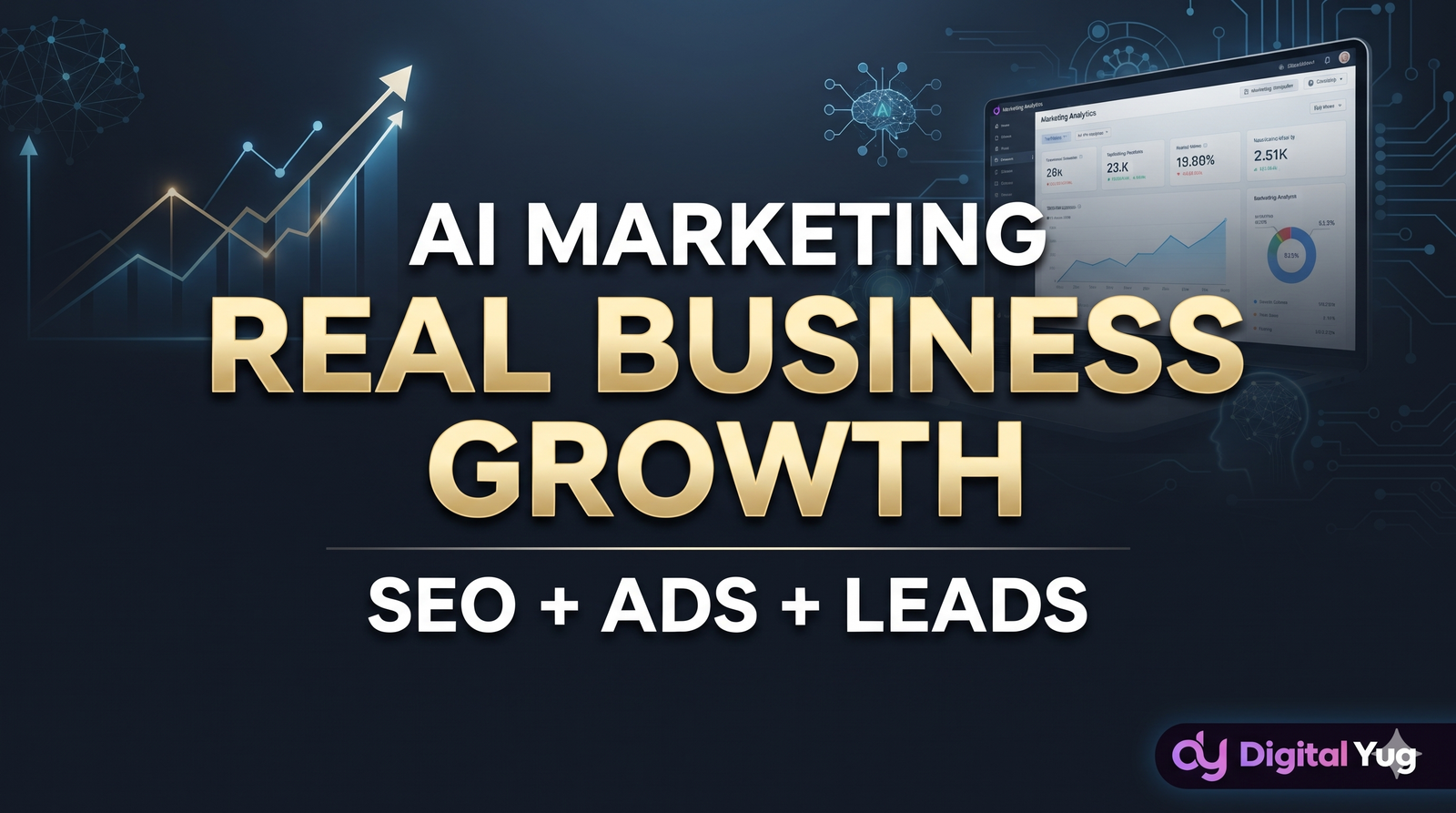
This is where AI-powered digital marketing becomes valuable.
By combining artificial intelligence, audience insights, creative content, search engine optimization, and performance tracking, businesses can make better marketing decisions without relying entirely on guesswork.
For growing companies, the real opportunity is not simply to use AI tools. It is to use technology alongside human judgment to attract the right audience and turn genuine interest into business growth.
What Is AI-Powered Digital Marketing?
AI-powered digital marketing uses artificial intelligence to support activities such as audience research, campaign analysis, content planning, customer segmentation, and performance optimization.
Instead of treating every marketing channel separately, businesses can use data to understand how their customers discover, evaluate, and choose a product or service.
For example, an education company might discover that parents search Google for course information, compare institutes through reviews, and finally contact the business after watching a student testimonial.
That journey involves multiple touchpoints. A connected marketing strategy helps each touchpoint support the next.
AI can help identify patterns, organize information, and speed up repetitive work. Human marketers remain essential for positioning, creative judgment, customer understanding, and responsible decision-making.
Why Traditional Digital Marketing Often Fails to Generate Leads
Many businesses invest in digital marketing but struggle to understand why the results remain inconsistent.
1. Marketing activity without a clear objective
Posting regularly on Instagram or running Google Ads can create visibility, but visibility alone does not guarantee revenue.
Before launching a campaign, businesses need to identify what success means. It could be qualified enquiries, booked appointments, course admissions, purchases, or a lower cost per acquisition.
The objective determines the strategy, the message, and the metrics that matter.
2. Attracting the wrong audience
A campaign can generate hundreds of clicks while attracting people who have little intention of buying.
Effective targeting requires more than selecting interests or demographic categories. It involves understanding customer problems, search intent, buying readiness, geographic relevance, and the questions people ask before making a decision.
3. A weak website experience
Imagine a potential customer clicks an advertisement but lands on a slow website with unclear information and no obvious next step.
The advertising campaign may have done its job, but the website has failed to convert the visitor.
A conversion-focused website should communicate the offer clearly, establish credibility, answer important objections, and make contacting the business straightforward.
4. Measuring impressions instead of business outcomes
Impressions, reach, likes, and video views can help explain campaign performance. However, they should not replace business metrics.
Businesses should also evaluate qualified leads, conversion rates, appointment bookings, customer acquisition costs, and revenue wherever reliable tracking is available.
The goal is to understand which marketing activities contribute to meaningful business outcomes.
How AI-Powered Marketing Can Improve Business Growth
AI becomes more useful when it supports a clearly defined marketing process.
Smarter audience research
AI tools can help organize customer feedback, identify recurring questions, analyze search themes, and develop initial audience segments.
For example, a healthcare provider may discover that prospective patients frequently ask about appointment availability, treatment options, specialist experience, and consultation procedures.
These insights can guide website content, advertising messages, and social media topics.
The important step is to validate AI-generated insights against actual customer behaviour rather than assuming every suggestion is accurate.
More relevant content creation
Content performs better when it addresses a specific customer need.
AI can help generate topic ideas, outline articles, repurpose long-form content into short videos, and create alternative messaging angles. Experienced marketers then refine the content to reflect the brand’s real expertise, tone, and audience.
This balance makes it possible to produce content efficiently without making every post sound generic.
Better campaign optimization
Performance marketing requires continuous observation and testing.
Marketers can evaluate which audience segments, landing pages, creative variations, and offers generate stronger results. AI-assisted analysis can help identify patterns, while controlled experiments determine whether a proposed change genuinely improves performance.
Businesses looking to improve campaign efficiency can explore Digital Yug’s performance marketing services.
Faster decision-making
When campaign information is organized properly, teams can spend less time preparing repetitive reports and more time investigating what needs improvement.
A useful report should answer three questions:
- What happened during the campaign?
- Why might those results have occurred?
- What should the team test or improve next?
AI can support this process, but decisions should still consider data quality, business context, and actual profitability.
Why SEO, Paid Advertising, and Content Work Better Together
One of the most common marketing mistakes is expecting a single channel to solve every growth problem.
SEO helps businesses appear when people search for relevant information, products, or services. Paid advertising can provide faster exposure to selected audiences. Social media and video content help communicate personality, expertise, and trust.
When these channels work together, they support different stages of the buying journey.
Search engine optimization builds long-term visibility
SEO helps a business earn relevant organic traffic by improving its website structure, content quality, search relevance, and overall user experience.
A Lucknow-based service provider, for example, may want to reach customers searching for digital marketing services in Lucknow. Helpful service pages, relevant local information, genuine business details, and useful supporting articles can strengthen its search presence.
However, rankings depend on competition, website quality, relevance, and many other factors. SEO should be treated as an ongoing process rather than a guaranteed shortcut.
Businesses can learn more about Digital Yug’s SEO services and how search visibility can support a wider marketing strategy.
Paid advertising supports targeted lead generation
Google Ads can help businesses reach people actively searching for particular services. Meta Ads can introduce offers to relevant audiences and help businesses reconnect with people who have already shown interest.
Campaign success depends on audience selection, creative quality, landing-page experience, tracking accuracy, and the value of the offer.
A well-managed campaign is not simply about spending more. It is about understanding which combinations of targeting, messaging, and conversion experience produce commercially useful results.
Explore Digital Yug’s digital marketing solutions to understand how performance marketing, creative production, and other digital channels can be approached as part of a coordinated strategy.
Content creates trust before the sales conversation
People rarely make every purchase decision after seeing a single advertisement.
They may compare providers, read articles, check reviews, watch videos, and ask questions before contacting a business.
Educational blogs, customer stories, expert videos, and clear service explanations help answer these questions before a sales conversation begins.
Content should not exist only to fill a publishing calendar. It should help the audience understand a problem and make a more informed decision.
How Different Industries Can Use AI-Powered Marketing
The right strategy depends on the industry’s customer journey and business objectives.
Education and coaching institutes
Education businesses can use search campaigns, admission-focused landing pages, course comparison content, and student information videos to reach prospective learners.
Instead of optimizing only for enquiry volume, institutes should evaluate lead quality, counselling attendance, admission conversion, and the cost of acquiring a student.
Healthcare and clinics
Healthcare marketing should prioritize accurate information, patient trust, clear service details, and responsible communication.
Search visibility, appointment-focused landing pages, informative content, and well-managed campaigns can help prospective patients find relevant services.
Sensitive health information must be handled carefully, and marketing claims should never promise medical outcomes that cannot be substantiated.
Restaurants and hospitality businesses
Restaurants can combine local search visibility, location-based advertising, menu content, attractive creative assets, and seasonal promotions.
Campaigns should be evaluated through meaningful outcomes such as reservations, enquiries, offer redemptions, or other reliably tracked business activity.
B2B companies and professional services
B2B businesses often have longer buying cycles. Educational content, detailed service pages, founder-led videos, case studies, and carefully targeted campaigns can help establish credibility.
In these industries, a smaller number of qualified enquiries may be more valuable than a large volume of unqualified leads.
How to Build a Practical AI-Powered Marketing Strategy
Businesses do not need to adopt every new tool at once. A structured approach is usually more effective.
Step 1: Define the business objective. Decide whether the immediate priority is qualified leads, online sales, local visibility, appointment bookings, or another measurable outcome.
Step 2: Understand the audience. Identify customer needs, buying objections, search behaviour, preferred communication channels, and geographic relevance.
Step 3: Fix the conversion journey. Review the website, service pages, landing pages, forms, contact options, and mobile experience before increasing advertising expenditure.
Step 4: Select the right marketing channels. Choose SEO, paid advertising, social media, video, or email based on the audience and objective rather than following trends blindly.
Step 5: Establish reliable tracking. Configure appropriate analytics, conversion events, campaign attribution, and lead-quality reporting while respecting privacy requirements.
Step 6: Test and improve. Run controlled tests, examine the results, document learnings, and invest more confidently in strategies that demonstrate value.
This approach creates a repeatable process instead of relying on occasional campaigns or isolated marketing activities.
How to Measure Whether Your Digital Marketing Is Working
A meaningful marketing dashboard should connect activity to business performance.
Important metrics include:
- Qualified lead rate: The percentage of enquiries that meet your business criteria.
- Cost per qualified lead: Marketing expenditure divided by the number of qualified leads.
- Landing-page conversion rate: The proportion of relevant visitors who complete the intended action.
- Customer acquisition cost: The cost associated with acquiring a customer, calculated using a clearly defined methodology.
- Revenue and return on ad spend: Useful measures when revenue attribution and tracking are sufficiently reliable.
- Organic search performance: Relevant search visibility, qualified organic traffic, and conversions from search.
No single metric tells the entire story. A campaign with a higher cost per lead may still be commercially stronger if it consistently attracts customers with greater lifetime value.
The objective is to understand profitability and growth potential, not simply to find the lowest possible number in a report.
Choosing the Right Digital Marketing Partner
A digital marketing partner should understand the business before recommending channels or budgets.
Look for a team that asks about your customers, margins, competition, existing sales process, and definition of a qualified lead.
The team should also explain how campaigns will be measured, how creative decisions are made, what information will be shared in reports, and how results will influence future work.
Digital Yug brings performance marketing, SEO, creative production, website development, and advertising together under one roof, with an approach focused on connecting marketing activity to business objectives.
For businesses that need a clearer growth plan, the next step is to review their current marketing process and identify the biggest opportunity for improvement.
Final Thoughts
AI-powered digital marketing is not about replacing every marketing task with automation. It is about making better use of data, reducing repetitive work, understanding customers more clearly, and improving the decisions that influence growth.
When SEO, paid advertising, creative content, and website conversion work together, businesses can develop a more consistent way to attract and engage potential customers.
The strongest strategy is rarely the one with the most tools or the most complicated dashboard. It is the one that understands the audience, communicates a convincing offer, measures meaningful outcomes, and improves through evidence.
If your business is ready to build a more structured digital presence, explore Digital Yug to learn more about its marketing services and potential next steps.
Start with a clear objective, build a connected strategy, and let measurable results guide the next decision.