
Introduction: Digital Marketing Is Changing, but Customers Still Matter Most
Imagine running a business where you need to create social media posts, manage advertising campaigns, write website content, respond to customer inquiries, and understand which marketing activities are actually generating sales.
Now imagine trying to manage all these responsibilities with a small team and a limited budget.
This is the reality for many businesses today. Marketing has become more competitive, customers have more choices, and simply publishing content regularly is no longer enough to guarantee results.
Artificial intelligence is changing how businesses approach these challenges.
AI-powered tools can help marketers analyze information, brainstorm campaign ideas, prepare content drafts, organize customer inquiries, and automate selected repetitive tasks. Work that once required several manual steps can sometimes be completed more efficiently with the right combination of technology and human expertise.
But there is a catch.
Using AI does not automatically mean better marketing. A poorly planned campaign can still waste money, generic content can still fail to attract customers, and inaccurate information can still damage a brand’s reputation.
The real opportunity lies in combining AI with a clear marketing strategy, an understanding of customers, and consistent measurement.
In this guide, we will explore 15 practical ways to use AI in digital marketing in 2026, explain which activities can benefit from automation, discuss useful tools, and show how businesses can introduce AI without losing the human connection that makes marketing effective.
Whether you own a small business, manage a marketing team, work as a freelancer, or are learning digital marketing, this guide will help you understand where AI fits into a modern marketing strategy.
What Is AI in Digital Marketing?
AI in digital marketing refers to the use of artificial intelligence technologies to support activities such as customer research, content development, search engine optimization, advertising, email marketing, analytics, and marketing automation.
Depending on the application, AI can identify patterns in data, generate content, classify information, suggest improvements, and assist with decisions.
For example, a digital marketing agency might use AI to brainstorm blog topics, prepare initial advertising copy, summarize campaign results, or organize customer feedback.
A local business might use an AI-assisted workflow to prepare a monthly content calendar or categorize incoming inquiries before a team member responds.
These applications can save time, but they still require human oversight. AI can misunderstand context, generate incorrect information, or suggest an approach that does not match a company’s audience.
Successful AI marketing therefore depends on three things:
- Technology: The tools used to support marketing activities.
- Strategy: The business goals and customer problems the campaign addresses.
- Human judgment: The experience, creativity, and verification needed to produce reliable results.
When these elements work together, AI can become a practical part of a broader digital marketing system.
Why AI Is Becoming Important for Digital Marketing
Digital marketing involves a wide range of activities, from attracting visitors to converting them into customers and maintaining long-term relationships.
AI can support several stages of this process.
First, it can help marketers process large amounts of information and identify areas that deserve further investigation. Second, it can accelerate the preparation of content and creative concepts. Third, it can help organize repetitive workflows and make reporting more efficient.
For smaller businesses, these capabilities may be particularly useful because marketing teams often have limited time and resources.
However, AI should not be treated as a replacement for understanding the market. Businesses still need to know what customers want, what makes their offering different, and why someone should choose them over a competitor.
The objective is not to automate every marketing activity. It is to identify where AI can improve the quality, speed, or consistency of the work.
15 Powerful Ways to Use AI in Digital Marketing
1. AI-Powered Search Engine Optimization
Search engine optimization helps websites become more discoverable when people search for relevant information, products, and services.
AI can assist with keyword research, topic clustering, content outlining, competitor analysis, and identifying questions that a page should answer.
For example, a digital marketing agency could investigate the different questions business owners ask about SEO services. These questions might inspire articles about local search visibility, website performance, content strategy, and measuring organic traffic.
AI can help organize these ideas, but marketers should validate search demand, assess competition, and examine actual search results before choosing a topic.
How businesses can use AI for SEO:
- Generate initial keyword and topic ideas.
- Group related topics into content clusters.
- Identify information gaps in existing articles.
- Draft title and meta description alternatives.
- Review content structure and readability.
- Summarize website performance data for further analysis.
Useful tools include Google Search Console, Google Trends, and AI writing assistants.
The most important principle is to publish content that genuinely helps readers. AI should improve the research and editing process, not become an excuse to publish large volumes of repetitive pages.
2. AI-Assisted Content Marketing
Content marketing helps businesses educate potential customers and demonstrate their expertise before asking them to make a purchase.
AI can support the creation of blog outlines, article drafts, email ideas, social media captions, video scripts, and content calendars.
Consider a company that sells accounting software to small businesses. Instead of publishing generic promotional posts, the company could create educational content explaining invoice management, common bookkeeping mistakes, and ways to organize business expenses.
AI can help structure these topics and prepare early drafts. Subject-matter experts should verify technical details and ensure the final content accurately reflects the product and its limitations.
A practical content workflow includes:
- Identify a real customer question.
- Research the topic using reliable sources.
- Create an outline.
- Use AI to assist with drafting.
- Add original examples and relevant expertise.
- Verify important claims.
- Edit for clarity and publish.
- Monitor engagement and search performance.
This process makes AI a supporting tool rather than the entire content strategy.
3. AI-Powered Social Media Marketing
Social media requires consistent planning, relevant content, and an understanding of what the audience wants to see.
AI can help businesses brainstorm post ideas, organize content calendars, draft captions, and adapt messages for different platforms.
For example, a restaurant could plan content around menu highlights, behind-the-scenes preparation, customer questions, special events, and seasonal offers.
An AI assistant can generate a first list of ideas, but the business should supply accurate information about its products, pricing, availability, and brand voice.
AI can also help repurpose a longer educational article into several shorter posts, provided each version is edited to fit the platform and audience.
The goal is not to post more content simply because it is easier to create. The goal is to publish material that is relevant, useful, and consistent with the business’s identity.
4. AI in Google Ads and Paid Advertising
Paid advertising can help businesses reach people who are searching for specific products or services, but poorly managed campaigns can spend money without producing worthwhile results.
AI features in advertising platforms can support bidding, audience targeting, creative testing, and campaign optimization, depending on the platform and campaign type.
AI writing assistants can also help prepare alternative headlines, descriptions, and calls to action.
For example, a coaching institute might test different messages that communicate course benefits, class schedules, and enrollment information.
However, advertising performance depends on more than ad copy. Landing page quality, audience relevance, pricing, competition, conversion tracking, and the actual offer all influence the outcome.
Before increasing an advertising budget, businesses should:
- Define the desired conversion.
- Check that tracking works correctly.
- Review search terms and audience relevance.
- Test landing pages and messaging.
- Monitor lead quality, not just clicks.
- Calculate the cost of acquiring a customer.
AI can support optimization, but marketers remain responsible for budget decisions, accurate claims, and campaign quality.
5. AI for Lead Generation
Lead generation involves attracting potential customers and helping them take the next step, such as requesting a quotation, booking a consultation, or submitting an inquiry.
AI can help businesses identify common customer questions, organize incoming leads, summarize permitted business research, and prepare relevant follow-up messages.
Imagine a real estate company receiving inquiries about several properties. An appropriately configured workflow could categorize inquiries by property type or requested information, allowing the sales team to respond more efficiently.
The system should not invent availability, prices, property details, or other important information.
Businesses should also respect privacy requirements and avoid collecting or processing personal data without an appropriate legal basis.
Effective lead generation is not simply about collecting as many contact details as possible. It is about attracting suitable prospects and helping them make informed decisions.
6. AI-Powered Email Marketing
Email marketing allows businesses to communicate directly with people who have chosen to receive their messages.
AI can help draft newsletters, suggest subject lines, develop educational email sequences, and adapt messages to different customer segments.
For example, a digital marketing agency might create an email series explaining local SEO, website conversion optimization, and the importance of tracking leads.
Each email should provide value rather than repeatedly pushing a sale.
AI may also assist with analyzing campaign data, but marketers should evaluate meaningful indicators such as clicks, conversions, unsubscribe rates, and qualified inquiries rather than focusing exclusively on open rates.
Always follow applicable consent, privacy, and unsubscribe requirements.
7. AI Chatbots and Customer Support
AI-powered chatbots can help businesses answer common questions, guide visitors to relevant pages, and collect basic inquiry information.
A chatbot on a service website might explain available services, identify the type of assistance a visitor needs, and direct the visitor to a contact form.
However, a chatbot should not pretend to know information that has not been verified. It should be able to direct customers to a human representative when a question is complex, sensitive, or outside its approved knowledge.
For business-critical information, the chatbot should rely on accurate, maintained documentation.
Useful applications include answering frequently asked questions, helping visitors navigate a website, and directing support requests to the appropriate team.
The best chatbot experience makes it easier to get help. It does not create additional barriers between the customer and the business.
8. AI for Website Conversion Rate Optimization
Getting visitors to a website is only part of digital marketing. Businesses also need to make it easy for those visitors to understand the offer and take the desired action.
Conversion rate optimization focuses on improving the proportion of visitors who complete an action, such as making a purchase or submitting an inquiry.
AI can help review customer feedback, suggest alternative headlines, identify confusing language, and generate hypotheses for testing.
For example, a service business might discover that visitors do not understand what happens after submitting an inquiry. It could test a clearer call to action that explains the next steps.
Before implementing changes, businesses should consider mobile usability, page speed, accessibility, trust signals, and the clarity of their offers.
AI-generated recommendations are hypotheses, not proof. Measure the impact of changes using suitable analytics or controlled experiments where possible.
9. AI-Assisted Video Marketing
Video can help businesses explain complicated products, demonstrate services, answer common questions, and introduce the people behind a brand.
AI tools can assist with script outlines, captions, transcription, editing, and repurposing longer recordings into shorter clips.
For example, a digital marketing agency could record an educational presentation about local SEO and turn it into several short videos addressing individual customer questions.
The original content should contain genuine knowledge or useful demonstrations. Automatically generating repetitive videos without meaningful value is unlikely to create a strong audience relationship.
Businesses should verify captions, respect music and footage licenses, and obtain permission before using another person’s voice or likeness.
10. AI for Graphic Design and Creative Production
Marketing materials often include social media graphics, banners, presentations, advertisements, and video thumbnails.
AI-enabled design tools can help generate visual concepts, resize designs, remove backgrounds, and accelerate selected production tasks.
For instance, an online store could develop several creative concepts for a product campaign and then refine the strongest design to match its brand guidelines.
Human review remains essential. A good design must communicate the right message, use readable typography, maintain visual consistency, and respect image licensing.
Businesses should avoid producing large quantities of nearly identical graphics simply because automation makes it possible.
Creative quality and message relevance matter more than the number of designs produced.
11. AI-Powered Customer Segmentation
Not every customer has the same needs, budget, or reason for purchasing.
Customer segmentation involves grouping audiences based on relevant characteristics, behaviors, or expressed preferences.
AI can assist with analyzing appropriately collected data and identifying patterns that marketers may want to investigate.
For example, an online store might distinguish between first-time buyers and returning customers to evaluate whether they respond differently to product education or loyalty communications.
Segmentation should be based on relevant, lawfully collected information. Businesses must be careful with sensitive personal data and avoid discriminatory or inappropriate targeting.
The objective is to make communication more relevant, not to make unsupported assumptions about individual customers.
12. AI for Marketing Analytics and Reporting
Marketing teams often work with data from websites, advertising platforms, social media, and customer relationship management systems.
AI can help summarize reports, explain trends, identify unusual changes, and suggest questions for further investigation.
For example, a campaign report might show that website traffic increased while qualified inquiries remained unchanged. This could prompt the team to investigate traffic quality, landing page relevance, conversion tracking, or the inquiry process.
AI should not be allowed to invent explanations for a change in performance. Marketers must verify calculations, understand the underlying data, and distinguish correlation from causation.
Useful metrics may include:
- Qualified leads.
- Conversion rate.
- Cost per lead.
- Customer acquisition cost.
- Return on advertising spend.
- Organic search clicks.
- Revenue attributable to a campaign, where measurement is reliable.
A clear report should help decision-makers understand what happened, what remains uncertain, and what should be investigated next.
13. AI for Local SEO and Google Business Profile Management
Local SEO helps businesses become discoverable when people search for nearby services or businesses in a particular area.
AI can help identify local content ideas, draft responses to common questions, and organize information about services and locations.
For example, a local marketing agency could prepare useful website content about SEO for restaurants, clinics, educational institutes, or home-service businesses.
However, local business information must remain accurate. Opening hours, addresses, phone numbers, service areas, and business descriptions should be checked before publication.
Businesses should never generate fake customer reviews or publish misleading location information.
A strong local SEO strategy combines accurate business information, relevant website content, genuine customer feedback, and a useful customer experience.
14. AI for Marketing Automation
Marketing automation uses software to carry out defined tasks or workflows with limited manual intervention.
AI can support selected steps, such as classifying information, drafting content, or summarizing records, while automation platforms connect different applications.
For example, a business could create a workflow in which a website inquiry is recorded in a customer management system and assigned to the appropriate team.
Before introducing automation, the business should map the existing process and identify the actual problem it wants to solve.
It should also consider data quality, error handling, permissions, and what happens when a workflow fails.
Start with a small, low-risk process. Test it carefully before using it for important customer communications or business operations.
15. AI for Competitive and Market Research
Understanding competitors can help businesses identify opportunities to improve their own products, positioning, and marketing.
AI can assist with summarizing publicly available information, organizing competitor messaging, and identifying themes that deserve closer examination.
For example, a business could compare the services, published pricing information, content topics, and customer FAQs presented by several competitors.
The objective should be to understand the market, not to copy another company’s content or distinctive creative work.
Any AI-generated summary should be checked against the original sources. Businesses should also respect website terms, privacy obligations, and restrictions on data collection.
Market research becomes valuable when it leads to a clearer understanding of customers and a more differentiated business strategy.
Best AI Tools for Digital Marketing in 2026
You do not need a separate tool for every marketing activity. Start with a small selection that fits your goals, budget, and existing workflow.
| Tool | Potential marketing use | Important consideration |
|---|---|---|
| ChatGPT | Brainstorming, drafting, campaign planning | Verify claims and review outputs |
| Google Gemini | Research assistance and content planning | Check sources and account limits |
| Perplexity | Research and source discovery | Confirm claims in original sources |
| Canva | Marketing graphics and presentations | Review asset licensing |
| CapCut | Short-form video editing | Check music and commercial-use rights |
| Google Trends | Topic and search-interest research | Relative interest is not exact search volume |
| Google Search Console | Website search performance | Requires verified website access |
| Google Analytics | Website behavior and conversion measurement | Configure events and consent appropriately |
| HubSpot | CRM and marketing workflows | Features and limits vary by plan |
| Zapier | Connecting applications and automating tasks | Test integrations and permissions |
Tool availability, pricing, and AI features can change. Review official documentation before choosing a tool for a business-critical workflow.
How Small Businesses Can Start Using AI in Digital Marketing
A common mistake is adopting several AI tools before identifying the problem they are supposed to solve.
A better approach is to begin with one specific business objective.
Step 1: Identify a Marketing Bottleneck
Determine where the team spends unnecessary time or struggles to achieve consistent results.
Possible examples include preparing content calendars, organizing customer inquiries, summarizing reports, or updating website content.
Step 2: Select One Suitable Tool
Choose a tool that addresses the identified task and fits your budget, technical capabilities, and privacy requirements.
Avoid paying for features you do not currently need.
Step 3: Establish a Clear Workflow
Define what information enters the process, what the tool should produce, and which tasks require human approval.
For example, AI might draft a customer response, while an employee checks the details before sending it.
Step 4: Measure the Results
Compare the process before and after introducing the tool.
Depending on the task, useful measurements could include time saved, error rates, lead quality, content production time, or conversion rates.
Step 5: Improve Before Expanding
Fix problems and document the workflow before introducing additional automation.
A small process that works reliably is more valuable than a complicated system that nobody understands.
AI in Digital Marketing: Common Mistakes Businesses Should Avoid
Relying Entirely on AI-Generated Content
AI-generated content may be inaccurate, repetitive, or disconnected from the customer’s actual needs.
Use AI to assist with drafting and organization, then add expertise, original examples, and careful verification.
Automating Without a Strategy
Automation can make an ineffective process run faster without making it more useful.
Define the business objective before introducing a tool.
Ignoring Customer Privacy
Marketing workflows may involve personal information, purchase history, and customer inquiries.
Use data responsibly, follow applicable privacy laws, and verify how a tool handles the information you provide.
Measuring Vanity Metrics Only
Impressions, likes, and clicks can provide useful context, but they do not always translate into business value.
Evaluate relevant outcomes such as qualified inquiries, sales, customer retention, and acquisition costs.
Expecting Guaranteed Results
AI cannot guarantee search rankings, advertising returns, lead generation, or revenue growth.
Marketing performance depends on competition, customer demand, execution, budget, and many other factors.
Is AI Replacing Digital Marketers?
AI is changing the tasks digital marketers perform, but marketing involves much more than producing text or generating advertisements.
Businesses still need people who can understand customers, develop positioning, manage budgets, evaluate data, communicate clearly, and make responsible decisions.
AI may reduce the time required for some repetitive tasks. At the same time, marketers who understand both technology and customer behavior can use these tools to improve their workflows.
For beginners, this means learning the foundations of digital marketing remains important.
Develop your understanding of SEO, paid advertising, analytics, content strategy, conversion optimization, and customer research. Then learn how AI can support those skills.
The most valuable approach is not to compete with AI at generating basic output. It is to learn how to use technology to solve meaningful marketing problems.
Frequently Asked Questions About AI in Digital Marketing
1. What is AI in digital marketing?
AI in digital marketing is the use of artificial intelligence to support activities such as SEO, content creation, advertising, customer research, analytics, and automation.
2. How can AI help a small business?
AI can help small businesses brainstorm content, draft marketing materials, summarize reports, organize inquiries, and automate selected repetitive tasks. Results depend on the quality of the workflow and the business’s needs.
3. Which AI tools are best for digital marketing?
The right tools depend on the task. Writing assistants can support content development, Canva can help with design, Google Search Console supports SEO monitoring, and analytics or automation platforms can assist with measurement and workflows.
4. Can AI improve SEO rankings?
AI can assist with research, content planning, and analysis, but it cannot guarantee rankings. Useful content, technical accessibility, competition, relevance, and other factors influence search performance.
5. Can AI write social media posts?
Yes. AI can generate draft captions, post ideas, and content calendars. Review every post for factual accuracy, audience relevance, brand voice, and current offers before publishing.
6. Is AI marketing expensive?
Not necessarily. Some tools offer free plans or limited access, while advanced features and larger workflows may require paid subscriptions. Start with the minimum tools needed for your objective.
7. Can AI automate lead generation?
AI can support parts of lead generation, including research, categorization, and selected follow-up workflows. Businesses must still ensure that lead information is accurate and that outreach follows applicable laws and consent requirements.
8. Is AI-generated marketing content good for customers?
It can be useful when it provides accurate, relevant information and is reviewed appropriately. Generic, repetitive, or misleading content can damage customer trust.
9. Will digital marketing jobs disappear because of AI?
The effect will vary by role and task. AI can automate some activities, but strategy, customer understanding, creative judgment, analytics, and accountability remain important. Marketers should continue developing adaptable skills.
10. How can a business measure the success of AI marketing?
Measure outcomes relevant to the objective, such as time saved, qualified leads, conversion rates, customer acquisition cost, or content performance. Compare results against a reliable baseline and account for other factors that may affect performance.
Final Thoughts: Use AI to Make Marketing More Useful, Not Just Faster
AI is creating new possibilities for digital marketing, from research and content creation to advertising, analytics, and workflow automation.
But technology alone does not create a successful marketing strategy.
Businesses need to understand their customers, communicate a clear value proposition, publish useful information, measure results, and improve their approach over time.
Start with one practical use case. Select a suitable tool, establish a reliable workflow, and measure whether it improves the result. Expand only when you have evidence that the additional complexity is worthwhile.
For freelancers and marketing professionals, developing AI skills alongside strong marketing fundamentals can create opportunities to deliver services more efficiently. For business owners, a careful approach can help reduce repetitive work while preserving quality and customer trust.
The future of digital marketing is not simply about using more AI. It is about combining technology, strategy, and human understanding to create better experiences for customers.
About Digital Yug
Digital Yug shares practical resources on SEO, performance marketing, content marketing, AI tools, and digital business growth.
Explore the Digital Yug blog to learn how businesses can strengthen their online presence, improve their marketing processes, and make more informed decisions about digital growth.
SEO publishing checklist
- Focus keyword: AI in Digital Marketing
- SEO title: AI in Digital Marketing: 15 Strategies for 2026
- URL slug:
ai-in-digital-marketing - Meta description: Discover 15 practical ways to use AI in digital marketing, from SEO and content creation to advertising, automation, lead generation, and business growth.
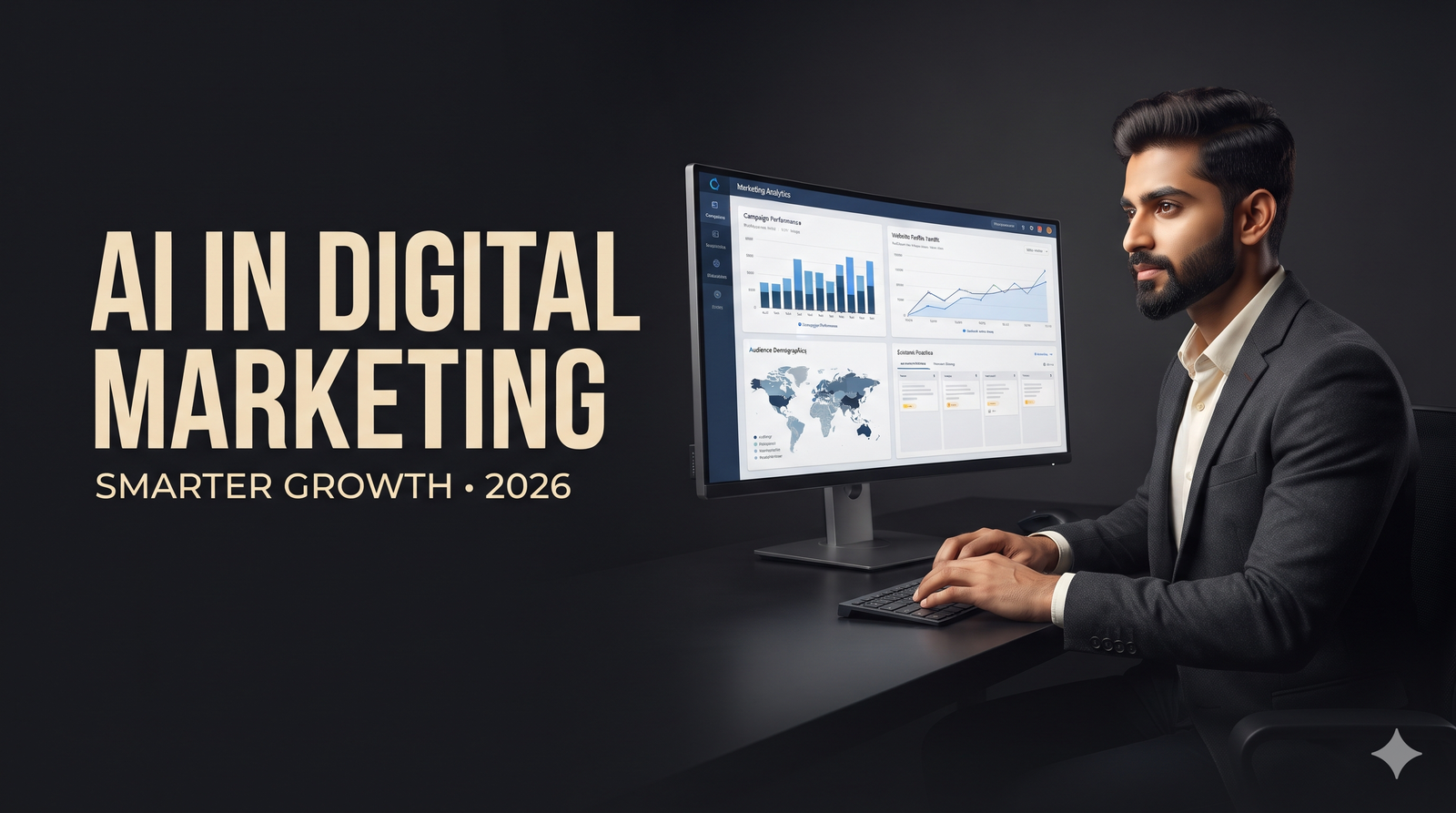
- Featured image alt text: AI in digital marketing strategies for SEO, advertising, content creation, and business growth.
- Internal links: Link naturally to your existing Digital Yug articles about AI-powered digital marketing, personal branding, and digital marketing services. Avoid linking an article to itself.
- External references: Use official documentation from Google Search Central, Google Ads, and the relevant AI tool providers when supporting specific technical claims.