
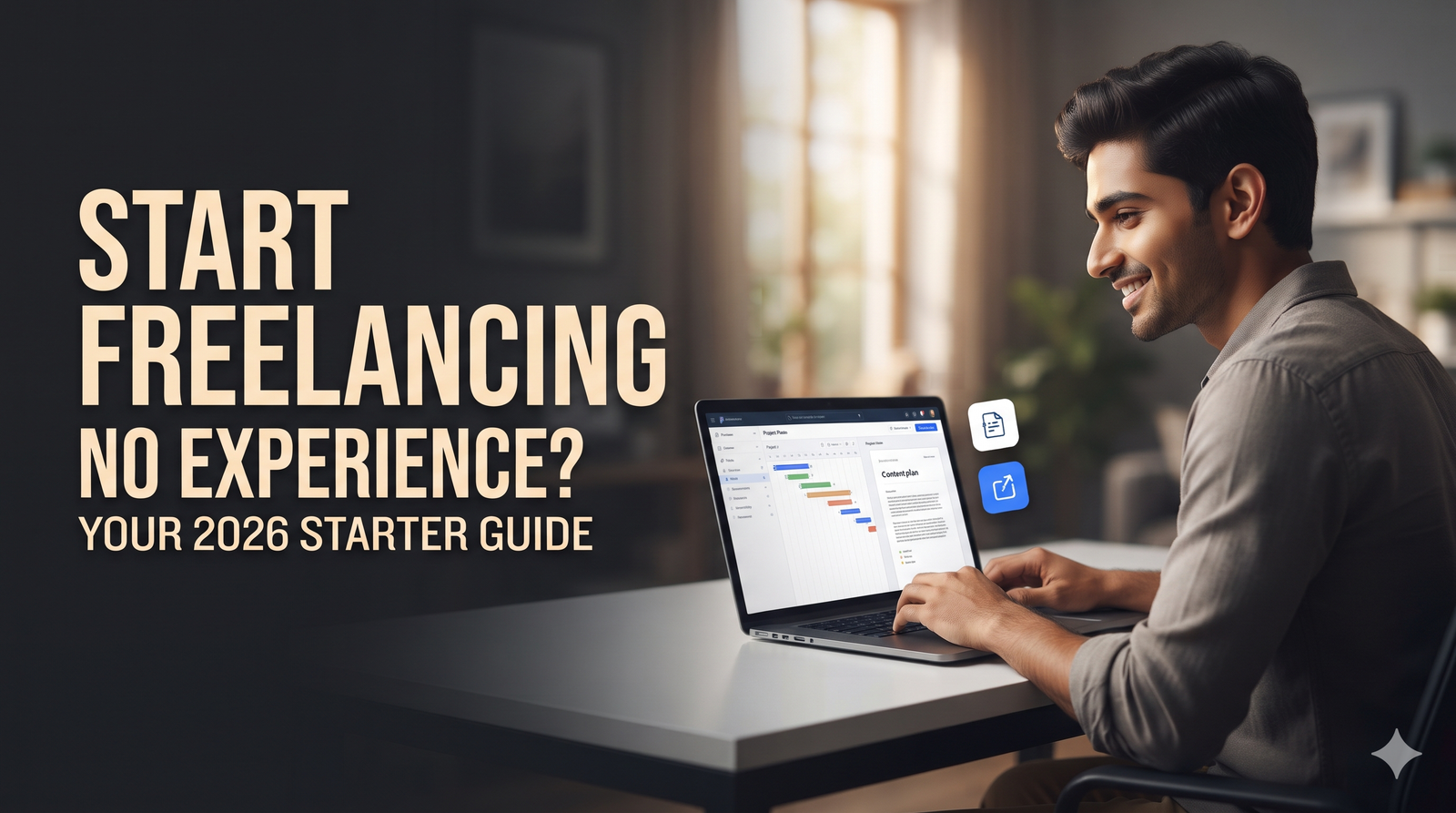
Introduction: You Don’t Need a Perfect Career to Start Freelancing
Imagine you have a laptop, an internet connection, and a desire to earn money using your skills. You want to work independently, but one question keeps coming back to your mind: Who will hire me when I have no experience?
Perhaps you are a college student looking for your first income opportunity. Maybe you already have a job but want to build an additional source of income. Or perhaps you have been watching videos about freelancing and remote work but have not taken the first step because everything seems confusing.
You are not alone in feeling this way.
Starting something new can be difficult when you do not know where to begin. People talk about earning online, finding international clients, building a personal brand, and working from anywhere. What they often leave out is the less glamorous part: learning a skill, practising consistently, handling rejection, and proving that your work is worth paying for.
That is what freelancing really involves.
Freelancing gives you an opportunity to offer services independently rather than working exclusively as an employee for one organization. Depending on your skills, you might write articles, design graphics, edit videos, manage social media, build websites, or provide other professional services.
You do not necessarily need a formal degree or years of employment to begin learning these skills. However, you do need the ability to deliver useful work, communicate professionally, and improve through feedback.
In this guide, we will explain how to start freelancing in 2026, even if you are a complete beginner. You will learn which skills to consider, how to build a portfolio without clients, where to find potential customers, how to approach pricing, and how to avoid common mistakes.
Most importantly, this guide focuses on realistic steps rather than promises of overnight success.
What Is Freelancing?
Freelancing means providing services to clients independently, usually in exchange for an agreed payment.
Instead of working exclusively for one employer, a freelancer may work with multiple clients, manage separate projects, and decide which services to offer.
For example, a small business might hire a freelance designer to create social media graphics. A YouTube creator might pay a video editor to edit weekly videos. A digital marketing agency might hire a freelance writer to prepare website articles.
The client pays for the agreed work, while the freelancer manages the delivery process, communication, and other responsibilities.
Freelancing can offer flexibility, but it also comes with uncertainty. Work may not arrive consistently, clients may have different expectations, and freelancers must manage their own time, expenses, and professional development.
It is therefore better to view freelancing as a service business rather than an effortless way to earn money online.
Why Is Freelancing Worth Exploring in 2026?
Businesses need many different kinds of support, from content production and website maintenance to design, marketing, research, and software development.
Some organizations hire full-time employees for these activities. Others work with independent professionals when they need a particular skill or temporary project support.
For beginners, this creates a possible route to building professional experience.
Freelancing can help you:
- Develop practical skills by working on real projects.
- Build a portfolio that demonstrates what you can do.
- Learn how to communicate with customers and manage deadlines.
- Explore different industries before choosing a long-term specialization.
- Work remotely when the client and service allow it.
- Develop an independent business over time.
However, these benefits are not automatic. Competition can be strong, and clients generally look for evidence that you can solve their problems.
The best starting point is to develop a skill that people genuinely need and learn how to demonstrate its value.
Step 1: Choose One Freelancing Skill Instead of Learning Everything
One of the most common beginner mistakes is trying to learn graphic design, video editing, coding, SEO, copywriting, and social media management at the same time.
This often creates the feeling of being busy without becoming particularly good at any one service.
A better approach is to choose one main skill, practise it, and build a small portfolio around it.
Here are some options worth exploring.
1. Content Writing
Content writers create articles, website pages, product descriptions, newsletters, and other written material.
This may suit you if you enjoy researching topics, explaining ideas, and organizing information clearly.
You should learn how to research reliable sources, write for a specific audience, edit your work, and follow a client’s brief. AI tools can assist with research and drafting, but the final content still needs accuracy, originality, and useful insights.
2. Graphic Design
Graphic designers create visual materials for businesses, creators, and organizations.
Examples include social media posts, advertisements, presentations, banners, and YouTube thumbnails.
You can start learning design principles with tools such as Canva and gradually develop your understanding of typography, composition, color, and visual hierarchy.
Simply knowing how to use a design application is not enough. Clients pay for visuals that communicate a message effectively.
3. Video Editing
Video editors help creators and businesses turn raw footage into finished videos.
Possible projects include YouTube videos, interviews, product demonstrations, educational content, and short-form social media videos.
You can begin with accessible editing software, practise cutting unnecessary footage, improve audio, add readable captions, and learn how to maintain a clear story.
A portfolio containing a few strong sample edits can help potential clients understand your abilities.
4. Social Media Management
Social media managers help businesses plan, publish, and evaluate content across social platforms.
The work may involve content calendars, captions, community management, basic design, and performance reporting.
This field may suit you if you understand online audiences and enjoy organizing content.
Start by learning platform-specific formats, content planning, brand communication, and basic analytics.
5. Search Engine Optimization (SEO)
SEO professionals help websites improve their visibility in search engines.
Beginner tasks may include keyword research, content optimization, internal linking, and basic website audits.
You should first understand search intent, useful content, technical accessibility, and the difference between search traffic and actual business results.
Avoid promising clients guaranteed rankings. Search visibility depends on many factors outside a freelancer’s control.
6. Website Development
Website developers create and maintain websites, landing pages, and web applications.
Beginners can explore website builders or learn HTML, CSS, JavaScript, and other relevant technologies.
This path generally requires more technical practice than some entry-level creative services, but it can provide opportunities for people who enjoy problem-solving.
Build working examples and test them carefully before offering development services to paying clients.
7. Virtual Assistance
Virtual assistants support businesses with administrative tasks such as organizing documents, managing schedules, preparing spreadsheets, conducting permitted research, and handling routine communications.
This may be suitable for people with strong organizational and communication skills.
Accuracy, confidentiality, reliability, and attention to detail are particularly important.
Which skill should you choose?
Do not choose a skill only because someone on social media claims it pays well.
Consider three questions:
- Do I enjoy this type of work enough to practise regularly?
- Can I become competent at it with the time and resources I have?
- Can I identify businesses or individuals who need this service?
The best first skill is one that fits your interests, your current abilities, and a real customer need.
Step 2: Learn the Basics Before Searching for Clients
You do not need to master every advanced feature before starting, but you should understand the fundamentals of the service you plan to offer.
For example, a beginner video editor should know how to organize footage, cut clips, manage audio levels, and export a video in the correct format.
A content writer should understand research, structure, grammar, editing, and the intended reader.
A designer should know how to create readable, balanced visuals and export files suitable for the intended platform.
Choose one learning resource, practise the essential tasks, and create small projects.
Free documentation, tutorials, and practice exercises can be enough to begin learning many digital skills. A paid course may be useful later, but purchasing a course does not replace practice.
Set a manageable learning schedule. Even 45–60 minutes of focused practice on most days can help you build momentum if you use that time consistently.
Step 3: Build a Portfolio Even If Nobody Has Hired You
This is where many beginners get stuck.
They want clients, but clients want to see their work. Without paid projects, it may seem impossible to demonstrate experience.
The solution is to create sample projects that show what you can do.
Your portfolio does not have to contain work for famous companies. It needs to demonstrate your skill clearly.
For example:
- Content writer: Prepare two or three original sample articles in a chosen niche.
- Graphic designer: Create a small set of social media graphics for a fictional brand.
- Video editor: Produce a sample edit using footage you have permission to use.
- SEO beginner: Prepare a sample website audit using publicly available information.
- Web developer: Build a working portfolio website or a small demonstration project.
- Virtual assistant: Create a sample spreadsheet, project tracker, or organized documentation workflow.
Clearly label practice work as a sample or concept project. Never pretend that a fictional client was a real customer.
For every sample, explain the problem, your approach, and the result you intended to achieve.
A focused portfolio with three excellent examples is often more persuasive than a large collection of unfinished projects.
Step 4: Create a Professional Freelance Profile
Once you have selected a skill and prepared some examples, create a profile that explains what you offer.
You can explore platforms such as:
- Upwork: https://www.upwork.com/
- Fiverr: https://www.fiverr.com/
- Freelancer: https://www.freelancer.com/
- LinkedIn: https://www.linkedin.com/
These are starting points, not guarantees of employment. Each platform has its own rules, competition, fees, and account requirements. Review the current terms before registering or accepting work.
Your profile should answer three basic questions:
- What service do you provide?
- Who is the service intended for?
- Why should a client consider hiring you?
Avoid vague descriptions such as “I can do all online work.”
A more useful description would be:
“I help small businesses create clear, well-researched website articles and blog content. My focus is on reader-friendly writing, accurate research, and organized delivery.”
Only make claims you can support with your skills and work.
Include relevant samples, a professional profile image if appropriate, clear service descriptions, and accurate contact information. You do not need to reveal unnecessary personal details to appear professional.
Step 5: Find Your First Freelance Client
Your first client can be the most difficult to secure because you have limited professional history.
Instead of waiting for someone to discover you, use a consistent approach to finding relevant opportunities.
Method 1: Apply to Suitable Projects
Search freelance platforms for projects that match your current ability.
Read the entire description before applying. Pay attention to the deliverables, required experience, deadlines, and budget.
Avoid sending the same generic application to every client.
A useful proposal briefly explains your understanding of the project, how you would approach it, and which relevant sample the client can review.
Method 2: Contact Small Businesses Directly
You can research businesses whose websites or public marketing materials suggest a genuine need for your service.
For example, a business with outdated website content might benefit from content improvement. A creator publishing videos regularly might need editing assistance.
Contact the business professionally and explain a specific, relevant way you could help.
Do not send mass messages, make unsupported accusations about their current work, or promise results you cannot guarantee.
Method 3: Use Your Professional Network
Tell relevant contacts what service you offer.
Friends, former colleagues, classmates, and professional communities may know businesses that need your skills.
You do not need to ask everyone to hire you. Simply explain what you do and share a portfolio when appropriate.
Method 4: Build Visibility Through Useful Content
You can demonstrate your knowledge by publishing helpful posts, short tutorials, case studies, and portfolio examples.
For instance, a beginner SEO freelancer could explain how to improve a page title or organize internal links.
Useful content can help potential customers understand your approach before contacting you.
Method 5: Work With Agencies and Other Freelancers
Marketing agencies, designers, developers, and content teams sometimes need additional support for specific projects.
Building professional relationships can introduce you to opportunities that are not publicly advertised.
Be clear about your availability, skills, turnaround times, and the type of work you can handle.
Step 6: Write a Proposal That Shows You Understand the Client
A proposal should not be a long biography. It should make it easy for the client to understand how you can help.
A simple structure is:
- Refer to the client’s specific project.
- Explain how you would approach the work.
- Mention a relevant sample or experience.
- Clarify the next step.
For example:
“Hi, I read your project description and understand that you need clear, engaging blog content for your website. I would begin by reviewing the target audience and article requirements, then prepare a structured draft with reliable research and careful editing. Here is a relevant writing sample: [insert your portfolio link]. If the approach fits your requirements, I would be happy to discuss the scope and delivery schedule.”
Personalize this message before sending it. Only include a portfolio link you actually own or are authorized to share.
A thoughtful, relevant proposal is generally more useful than a lengthy message full of generic claims.
Step 7: How Much Should Beginners Charge?
There is no single correct price for every freelancer.
Rates depend on the type of service, project complexity, quality, location, experience, turnaround time, and client requirements.
Some projects are priced hourly. Others use a fixed fee for a clearly defined deliverable. Ongoing work may be arranged through a monthly agreement.
Before setting a price, consider:
- The time required to complete the work.
- The level of research or technical expertise involved.
- The number of revisions included.
- Software, equipment, and other business expenses.
- Platform fees and applicable taxes.
- The value and scope of the deliverable.
For example, if a project requires several hours of research, production, editing, and communication, pricing only for the final deliverable may cause you to underestimate the real workload.
You can start with a modest, clearly scoped project while building experience, but avoid committing to unlimited revisions or unrealistic deadlines.
Before starting, confirm the deliverables, payment amount, schedule, revision policy, and ownership or licensing arrangements in writing.
Do not assume that higher prices guarantee better clients or that low prices are always necessary to win work.
Step 8: Use AI Tools to Work More Efficiently
AI tools can support parts of a freelancer’s workflow, depending on the service being delivered.
A writer might use an AI assistant to brainstorm article structures. A designer might explore visual concepts. A video editor might use transcription or captioning tools. A developer might use coding assistance to investigate a problem.
The important distinction is between using AI as support and relying on it without checking the result.
Before delivering work, verify facts, inspect the output, respect licensing requirements, and ensure the final product meets the client’s brief.
Never upload confidential client information into an AI service unless you have the necessary permission and suitable data protections.
If a client has restrictions on AI use, follow the agreed requirements.
Your value comes from solving the client’s problem. The software is simply one part of the process.
Step 9: Communicate Professionally and Deliver on Time
Technical ability matters, but professional communication can also influence whether clients choose to work with you again.
At the start of a project, confirm what the client expects. If requirements are unclear, ask focused questions before beginning.
During the project:
- Give realistic delivery estimates.
- Share progress updates when appropriate.
- Tell the client promptly if a problem affects the schedule.
- Follow the agreed scope.
- Check the final work before delivery.
- Keep records of approvals and important project decisions.
If a client requests additional work beyond the original agreement, discuss the change before proceeding.
Professionalism does not mean accepting every demand. It means communicating clearly, respecting agreements, and handling disagreements constructively.
Step 10: Protect Yourself From Freelancing Scams
People who are new to online work can be vulnerable to offers that promise unusually high earnings for little effort.
Be cautious if someone asks you to pay an unexplained registration fee to obtain a job, purchase gift cards, share passwords, or transfer money on their behalf.
Other warning signs include unclear job descriptions, pressure to act immediately, suspicious payment arrangements, and requests for sensitive personal information before there is a legitimate reason to provide it.
Use appropriate contracts and secure payment arrangements. When working through a freelance platform, understand its payment protection rules and avoid taking actions that violate its terms.
For direct clients, agree on milestones or an advance payment when appropriate, especially for substantial projects.
If something feels suspicious, pause and verify the opportunity independently.
A Practical 30-Day Freelancing Roadmap for Beginners
You do not need to build an entire business in one weekend. A structured first month can help you move from uncertainty to a more organized starting point.
Days 1–7: Choose and Learn
Select one skill, study its fundamentals, and practise the essential tasks.
Do not spend the entire week comparing courses and tools. Focus on learning by doing.
Days 8–14: Build Your Portfolio
Create two or three sample projects that demonstrate your abilities.
Review your work critically. Correct mistakes, improve presentation, and explain what each sample demonstrates.
Days 15–21: Prepare Your Profile and Start Outreach
Create a focused profile, publish your portfolio, and identify relevant opportunities.
Send personalized proposals or contact suitable potential clients professionally.
Days 22–30: Improve and Follow Up
Review responses, improve weak portfolio examples, and refine your proposals.
Follow up politely when appropriate. Continue practising your skill while learning which types of projects are most relevant to your abilities.
What should you expect after 30 days?
You may have a clearer skill focus, a portfolio, a professional profile, and a better understanding of how to approach potential clients. You might receive inquiries or even secure a project, but paid work is not guaranteed within a fixed period.
The purpose of the first month is to establish a repeatable process, not to promise a specific income.
Common Freelancing Mistakes Beginners Should Avoid
Trying to Offer Every Service
A broad list of unrelated services can make it difficult for clients to understand your expertise. Start with a focused offer and expand when you have the skills and evidence to support it.
Waiting Until You Feel Completely Ready
You should learn the fundamentals before accepting paid work, but you do not need to know everything. Build sample projects, seek feedback, and improve steadily.
Copying Another Freelancer’s Portfolio
Copying another person’s work or presenting it as your own can damage your reputation and create legal problems. Create original samples or use materials you have permission to work with.
Accepting Unclear Projects
Do not begin substantial work without understanding the deliverables, deadlines, payment terms, and revision expectations.
Believing Every Online Income Claim
Screenshots and testimonials do not tell the whole story. Evaluate opportunities based on realistic requirements, verifiable information, and the value you can deliver.
Ignoring Financial Records
Keep track of payments, expenses, invoices, and relevant tax obligations. Freelance income can fluctuate, so avoid treating an unconfirmed project as guaranteed earnings.
Frequently Asked Questions About Freelancing in 2026
1. Can I start freelancing with no experience?
Yes, you can begin learning and building a freelance business without previous paid experience. Start by developing a marketable skill, creating honest portfolio samples, and applying for suitable projects.
2. Which freelancing skill is best for beginners?
There is no universally best skill. Content writing, graphic design, video editing, virtual assistance, social media support, and website development are possible starting points. Choose based on your abilities, interests, and customer demand.
3. Can students start freelancing?
Students can explore freelancing while studying if they can manage their time and meet client commitments. Check applicable platform age requirements and eligibility rules before creating an account.
4. Do I need a laptop to start freelancing?
It depends on the service. Some tasks can be performed using a smartphone, while development, complex design, and many video-editing workflows are more practical with a computer.
5. Which websites can help me find freelance work?
You can explore Upwork, Fiverr, Freelancer, LinkedIn, and professional networks. Opportunities, fees, eligibility, and competition vary across platforms.
6. How long does it take to get the first freelance client?
There is no fixed timeline. It depends on your skills, portfolio, niche, pricing, outreach, competition, and the type of clients you approach. Avoid anyone who guarantees paid work within a specific number of days.
7. Can I use AI while freelancing?
Yes, when the client’s requirements, applicable terms, and the nature of the work allow it. Verify outputs, protect confidential information, and remain responsible for the quality of your deliverables.
8. Is freelancing a stable career?
Freelancing can become a sustainable career, but income is not always predictable. Building repeat clients, maintaining savings, managing expenses, and consistently developing your skills can help reduce uncertainty.
9. Do freelancers need to register a business in India?
Requirements depend on the nature and scale of the activity and the applicable legal and tax rules. Check current official guidance or consult a qualified professional if you need advice for your specific circumstances.
10. How can I avoid freelance job scams?
Verify the client, review payment terms, avoid unexplained upfront fees, protect sensitive information, and use appropriate written agreements. Be particularly careful with offers that promise unusually high earnings for minimal effort.
Final Thoughts: Start Small, Build Skills, and Earn Trust
Freelancing can provide a way to turn a practical skill into an independent service business. But the journey usually involves more than creating a profile and waiting for work.
You need to learn, practise, demonstrate your abilities, communicate clearly, and understand what clients actually value.
If you are starting today, choose one skill. Build a small portfolio. Find a few relevant opportunities and approach them thoughtfully. Treat every project as a chance to improve your process and professional judgment.
Do not measure your progress only by the money you earn in the first few weeks. Measure it by the quality of your work, the skills you develop, the conversations you start, and the reliability you build.
A first project may be small, and the path to consistent work may take time. That does not make the effort meaningless.
The goal is to become someone clients can trust to solve a particular problem.
Start with one skill, prove what you can do, and improve with every project. That is a more realistic foundation for freelancing than chasing shortcuts or promises of quick money.
About Digital Yug
Digital Yug shares practical guides on digital marketing, SEO, AI tools, freelancing, and online business. Our goal is to help readers understand digital opportunities and develop skills they can apply in the real world.